 PiMemo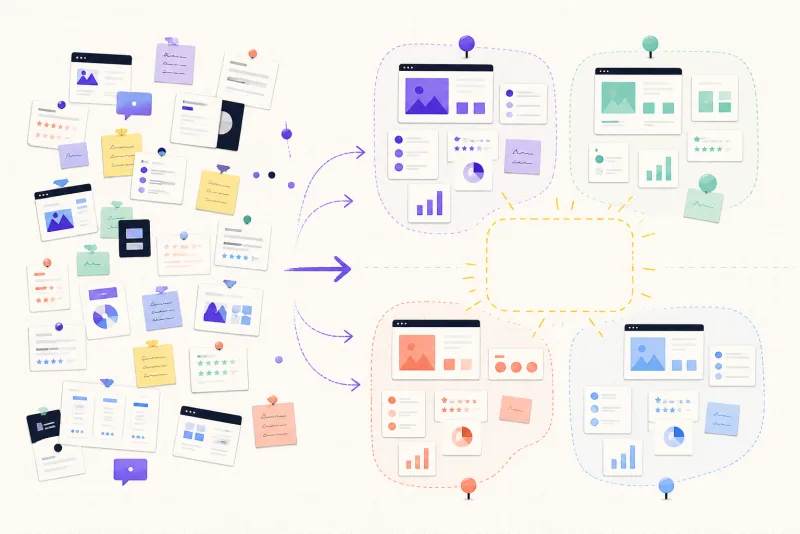
Competitor research is often treated as a list-making exercise. A founder opens a spreadsheet, adds ten company names, copies their pricing and features, and calls the market understood.
The result looks organized, but it rarely improves a decision.
Useful startup competitor research should answer a sharper question: where can this product create value that customers do not already receive from an existing option? That requires more than tracking features. It means understanding the alternatives customers choose, the situations that trigger a search, the promises competitors make and the evidence behind their traction.
This guide presents a practical workflow for turning scattered market information into a view your team can use.
Start with the decision, not the competitor list
Before collecting anything, write down the decision the research must support. Examples include:
- Which customer segment should we enter first?
- Is our proposed workflow meaningfully different from existing tools?
- What do customers dislike about the current alternatives?
- Which capability is expected in the category, and which could differentiate us?
- Is the market crowded, or are competitors simply using similar language?
A clear decision keeps the research bounded. Without it, every new link feels relevant and the project expands indefinitely.
Create a short research brief containing:
- The decision to make.
- The customer and situation being studied.
- The assumptions that currently feel uncertain.
- The evidence needed to increase or reduce confidence.
- A deadline for synthesis.
Pin this brief at the top of the board. It becomes the filter for everything collected later.
Map alternatives the way customers see them
Startups often define competitors too narrowly. Customers do not compare products according to industry databases; they compare every available way to make progress.
Map at least four types of alternatives:
Direct competitors
Products aimed at a similar customer, problem and workflow. These are the obvious companies that appear in comparison searches and sales conversations.
Indirect competitors
Products that solve the same underlying job through a different workflow. A visual research tool may compete with documents, spreadsheets, bookmarks, whiteboards or project-management software.
Manual workarounds
The improvised process customers have assembled from general-purpose tools. These workarounds reveal what people value enough to do manually and where friction has become normalized.
Doing nothing
In many early markets, inertia is the strongest competitor. If the pain is not urgent enough to change behavior, a technically superior product still struggles.
Place these alternatives in separate groups. The visual distance between groups helps the team distinguish a crowded feature category from the broader job customers are trying to complete.
Collect evidence, not impressions
Every claim on the board should connect to a source. A useful evidence hierarchy includes:
- Product pages and documentation for current capabilities.
- Pricing and packaging pages for commercial strategy.
- Release notes for product direction and momentum.
- Customer reviews for repeated praise and frustration.
- Sales pages and advertisements for positioning.
- Community conversations for customer language and workarounds.
- Job listings for clues about strategic investment.
- Interviews with buyers or former users for context behind decisions.
Capture the relevant excerpt or screenshot beside the source link. Add the collection date because pricing, positioning and products change.
Avoid turning a competitor's claim into your own conclusion. “Built for fast-moving teams” is positioning copy, not evidence that the product makes a team faster.
Build consistent competitor profiles
Comparison becomes useful only when every competitor is examined through the same lens. Create one frame per company with a consistent structure:
| Dimension | Question to answer |
|---|---|
| Target customer | Who is the product explicitly designed for? |
| Trigger | What situation causes someone to look for it? |
| Core promise | What outcome does the product lead with? |
| Workflow | How does a user move from input to outcome? |
| Pricing | What does the company charge for, and where are the limits? |
| Proof | Which customers, results or behaviors support the promise? |
| Friction | What complaints or workarounds appear repeatedly? |
| Momentum | What has changed recently? |
Do not score every feature unless a feature directly affects the customer decision you are studying. Exhaustive matrices create false precision and hide the differences that matter.
Synthesize the market visually
Once the profiles contain enough evidence, stop collecting and rearrange the board. Synthesis begins when information moves out of company-specific frames and into shared patterns.
Create four synthesis areas:
Category expectations
Capabilities or promises that appear across most alternatives. These may be necessary to enter the market, but rarely produce differentiation.
Positioning clusters
Groups of competitors using similar language, targeting similar customers or emphasizing similar outcomes. Naming each cluster makes crowded narratives visible.
Repeated customer friction
Complaints, missing workflows and manual fixes that appear across more than one source. Keep the original customer quotes attached to each cluster.
Open space
Needs, segments or workflows that appear important but poorly served. Treat these as hypotheses, not automatic opportunities.
This is where an infinite canvas is more useful than a fixed table. Evidence can stay connected to its source while being regrouped around the pattern it supports.
You can start with the suggested structure on the PIMEMO startup competitor research board.
Turn gaps into opportunity statements
A market gap is not valuable simply because it exists. Some gaps are empty because customers do not care about them.
Translate each promising pattern into an opportunity statement:
For [customer] in [situation], existing alternatives create [specific friction] because [reason]. We believe a product that provides [different outcome or workflow] could be valuable, if [critical assumption] is true.
Then attach:
- Evidence supporting the opportunity.
- Evidence contradicting it.
- The customer behavior that would indicate demand.
- The riskiest remaining assumption.
- The smallest validation step.
This prevents a visually interesting pattern from becoming an unsupported roadmap commitment.
Use Pi as a research partner, not an authority
AI can accelerate competitor research when the task is explicit. Useful prompts include:
- Find recent pricing or packaging changes for these companies.
- Compare how each competitor describes the customer's desired outcome.
- Identify contradictions between product claims and customer reviews.
- Suggest missing alternatives based on the job customers are trying to complete.
- Summarize this evidence cluster without removing minority viewpoints.
Pin useful findings back to the board with their sources. Verify any claim that affects a strategic decision, especially pricing, product capabilities and company status.
The goal is not to outsource judgment. Pi helps expand and organize the evidence; the team still decides what matters.
Run a 90-minute competitor research sprint
For an early directional decision, use this compact format:
Minutes 0–10: define the question
Write the target customer, decision and three uncertain assumptions.
Minutes 10–30: map alternatives
Add direct competitors, indirect competitors, manual workarounds and the option to do nothing.
Minutes 30–55: capture decisive evidence
Each participant researches a subset of alternatives using the shared profile structure.
Minutes 55–75: cluster patterns
Move copies of evidence into expectations, positioning clusters, customer friction and open-space areas.
Minutes 75–90: define the next move
Write one to three opportunity statements and assign a validation action to each.
This sprint does not replace deeper research. It creates a shared map and reveals where deeper work is worth the time.
Common mistakes to avoid
Copying features without understanding the job
A feature is meaningful only in the workflow and situation where a customer uses it.
Treating all competitors as equally relevant
Prioritize by overlap with the customer, trigger and desired outcome—not by company visibility.
Using old screenshots as current truth
Add dates and revisit evidence that may change quickly.
Ignoring contradictory evidence
Keep exceptions visible. They often reveal important segments or boundary conditions.
Ending with a SWOT table
SWOT can summarize discussion, but it does not replace source-backed opportunity statements and validation steps.
What a useful final board should contain
At the end of the project, someone outside the research session should be able to see:
- The decision the research supports.
- The alternatives customers can choose.
- A consistent profile for each priority competitor.
- Source-backed patterns across the market.
- Repeated customer friction and contradictory evidence.
- A small number of opportunity hypotheses.
- The next validation action and its owner.
That is the difference between a competitor archive and a strategic research workspace.
For the next step, read the customer interview synthesis guide to connect market patterns with first-hand customer evidence. You can also follow the product research workflow, explore the T2D3 SaaS growth framework, or browse the PIMEMO Research Library.