 PiMemo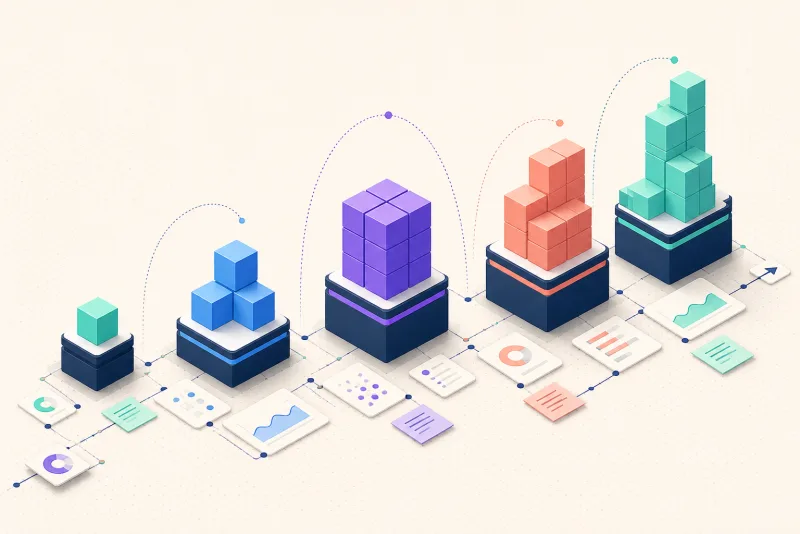
T2D3 sounds almost too simple: triple, triple, double, double, double. Five words describe a five-year revenue trajectory that can take a SaaS company from early product-market fit to more than $100 million in annual recurring revenue.
The idea is memorable because the arithmetic is clean. The execution is not.
T2D3 is best understood as a map of how a venture-scale SaaS company must evolve—not merely a target pasted into a financial model. Every step asks the company to find a larger source of demand, improve retention, build new operating capacity and replace assumptions with evidence.
This guide explains the framework, where it came from and how founders can turn it into a practical research system rather than an intimidating slogan.
What does T2D3 mean?
T2D3 stands for:
- Triple annual recurring revenue in year one.
- Triple it again in year two.
- Double it in year three.
- Double it in year four.
- Double it in year five.
Starting at $2 million ARR, the classic trajectory looks like this:
| Stage | Growth target | ARR milestone | New ARR required during the year |
|---|---|---|---|
| Starting point | — | $2M | — |
| Year 1 | 3× | $6M | $4M |
| Year 2 | 3× | $18M | $12M |
| Year 3 | 2× | $36M | $18M |
| Year 4 | 2× | $72M | $36M |
| Year 5 | 2× | $144M | $72M |
The percentages slow down, but the absolute amount of new revenue grows dramatically. Doubling from $72 million requires adding more ARR in one year than the company created across all earlier years combined.
That is the central insight hidden inside the acronym: the growth rate becomes smaller while the organizational challenge becomes larger.
Where did the framework come from?
Battery Ventures investor Neeraj Agrawal introduced the T2D3 idea in 2015 while describing the go-to-market journey of successful enterprise SaaS companies. His original model begins with product-market fit, moves through the first repeatable sales motion and then expands into management layers, international markets and a mature organization.
Agrawal framed the journey like a mountain climb. A company does not reach the summit in one move; it passes through distinct stages, and each stage demands a different focus. He also made an important qualification: T2D3 is not the only route to SaaS success.
That caveat matters. T2D3 emerged from the venture-backed enterprise software world. It describes a path capable of supporting very large outcomes, not a universal test of whether a company is healthy or worthwhile.
You can read Agrawal's original explanation at Battery Ventures and the Whatagraph overview that inspired this article.
T2D3 starts after product-market fit
The framework is often misapplied to a company that is still searching for a market. Before meaningful product-market fit, a triple can result from a tiny base, one unusually large contract or a burst of founder energy. It does not necessarily prove that growth is repeatable.
The more useful starting conditions are:
- A clearly defined customer and urgent use case.
- Evidence that customers reach the promised outcome.
- Retention strong enough for recurring revenue to compound.
- A repeatable path from demand to closed business.
- A market large enough to support the next order of magnitude.
- Enough gross margin and capital efficiency to finance growth.
If those conditions are uncertain, the immediate objective is not to force the first triple. It is to validate the growth engine.
Our SaaS idea validation board provides a useful structure for collecting the problem, customer, market and willingness-to-pay evidence before committing to a scale plan.
What changes at each stage?
The same go-to-market motion rarely survives all five years unchanged. Treat each milestone as a new research question.
From $2M to $6M: prove the first repeatable engine
At this stage, founders are often still central to sales. That can be an advantage: they hear objections directly, understand why customers buy and can adjust the product quickly.
The risk is confusing founder skill with a scalable system. The company needs to identify:
- Which customer profile closes and retains best.
- Which trigger makes the problem urgent.
- Which message consistently earns attention.
- Which steps in the sales process can be repeated by someone else.
- Which early customers should be avoided despite available revenue.
The output should be a narrow, evidence-backed ideal customer profile and a sales motion that the first team can reproduce.
From $6M to $18M: turn founder knowledge into a system
The second triple requires more than adding salespeople. Customer knowledge must move from individual memory into onboarding, qualification, messaging, enablement and product priorities.
This is where weak retention becomes expensive. New bookings may look impressive while churn quietly removes the base needed for compounding. Founders should watch cohorts, expansion, time to value and the reasons customers fail to adopt—not only top-line ARR.
The operating question changes from “Can we sell this?” to “Can the organization repeatedly acquire and retain good-fit customers?”
From $18M to $36M: add management without losing signal
The first double often introduces a new kind of complexity. More teams, managers and customer segments create distance between leadership and the market.
The company needs a reliable research loop:
- Capture customer and competitive evidence.
- Synthesize patterns across functions.
- Turn patterns into explicit decisions.
- Measure the outcome of those decisions.
- Preserve contradictory evidence for the next review.
Without that loop, scale produces more activity but not necessarily more learning.
From $36M to $72M: expand deliberately
Growth may now require new geographies, larger accounts, additional products or partner channels. Each option contains a different set of assumptions.
A new market is not merely the existing playbook translated into another language. Buying behavior, regulation, integrations, sales cycles and support expectations can change. Expansion should therefore begin as a portfolio of testable bets with clear success and stop conditions.
From $72M to $144M: balance growth with durability
At this scale, the company must add an enormous amount of new ARR while operating a much larger installed base. Reliability, security, governance, forecasting and leadership depth become part of the growth product.
The question is no longer simply how fast the company can acquire demand. It is whether growth, retention and operating efficiency can reinforce one another. Metrics such as net revenue retention, gross margin, payback period and the Rule of 40 help expose whether the machine is becoming more durable or merely more expensive.
T2D3 is a benchmark, not a strategy
The framework tells you the shape of an exceptional revenue curve. It does not tell you how to produce it.
It cannot decide:
- Which customer segment should be your beachhead.
- Whether the market is large and urgent enough.
- Which acquisition channel can scale economically.
- What product advantage will improve retention.
- How much capital risk is appropriate for the founders.
- Whether a slower, profitable path better matches the business.
That distinction prevents two common mistakes.
The first is reverse-engineering a forecast without an evidence-backed growth engine. A spreadsheet can always multiply ARR by three. It cannot make the market cooperate.
The second is treating a missed milestone as proof of failure. Many valuable SaaS companies grow more slowly, prioritize profitability earlier or serve markets where hypergrowth is neither available nor desirable.
Use T2D3 to expose the scale of the challenge and the assumptions behind it. Do not use it to erase context.
Build a T2D3 evidence board
A useful T2D3 board connects financial milestones to the evidence and operating changes required to reach them. Create six areas on the canvas.
1. Starting evidence
Pin the current ARR, customer count, average contract value, growth rate, retention cohorts and cash position. Separate measured facts from estimates.
2. Five milestone frames
Create one frame for each growth year. Include the target ARR, new ARR required, assumed customer count, contract value, churn, expansion and hiring capacity.
3. Growth engine
Map acquisition channels from first touch to retained customer. Attach conversion evidence, sales-cycle data and capacity constraints to each stage.
4. Retention evidence
Cluster renewal reasons, churn reasons, adoption barriers and expansion triggers. Keep customer interview notes connected to the metrics they explain.
The customer interview synthesis guide shows how to move from raw conversations to evidence-backed product decisions.
5. Strategic bets and risks
For each proposed market, product or channel, write the assumption, supporting evidence, contradictory evidence, owner and next test. A risk without an action is only a worry.
6. Decision log
Record what changed, why it changed and what result would cause the team to revisit the decision. This stops the plan from becoming a polished artifact that nobody trusts three months later.
Five questions to ask before adopting T2D3
Before turning the framework into a company goal, answer these questions:
- Do we have retention-based evidence of product-market fit?
- Is the reachable market large enough for the required new ARR?
- Which growth engine can scale, and what evidence supports that belief?
- What must become true operationally at the next milestone?
- What are we willing to trade for speed—and what will we refuse to trade?
If the answers are vague, that is useful. The gaps reveal the research agenda.
The real value of T2D3
T2D3 is powerful because it makes exponential growth concrete. It shows that building a venture-scale SaaS company is not one continuous sprint. It is a sequence of increasingly difficult transitions.
The founder's job is not to believe the curve hard enough. It is to continually build the evidence, product, team and operating system that make the next transition plausible.
That is also why the framework belongs on a living research canvas rather than only in a forecast. Every revenue target rests on customer behavior, market assumptions and organizational constraints. When those inputs remain visible, the team can discuss the plan honestly and update it as reality changes.
Start by mapping the first uncertain assumption—not the fifth-year valuation. Explore Pimemo for founders, follow the product research guide, or browse the PIMEMO Research Library to turn the growth thesis into a board your team can test.