 PiMemo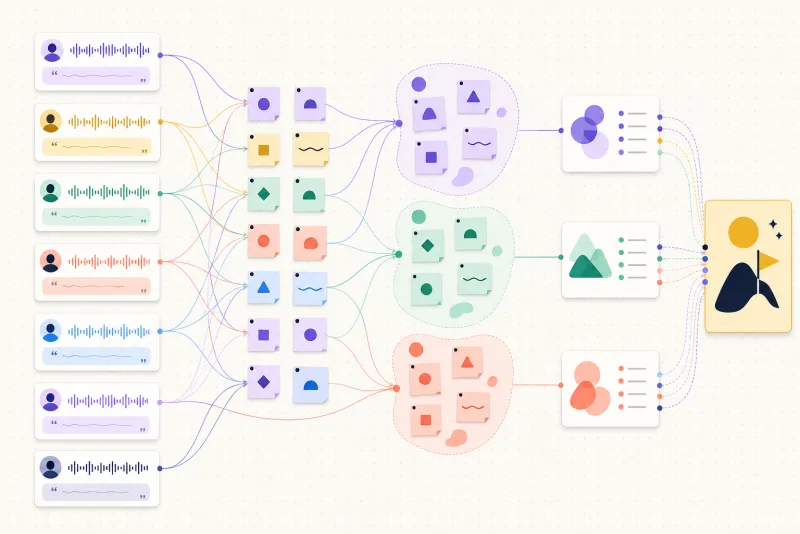
Customer interviews create an unusual problem: after every conversation, the team feels informed, but the combined evidence becomes harder to see.
One person remembers a vivid complaint. Another remembers a feature request. The founder recalls the participant who confirmed the original idea. A document fills with summaries, yet no one can explain which conclusions are strongly supported and which came from a single memorable moment.
Customer interview synthesis is the process of turning those conversations into a structured, traceable understanding. The goal is not to compress every interview into a short summary. It is to preserve the evidence while revealing patterns that can support a product decision.
This guide shows how to move from recordings and notes to observations, themes, insights and action.
Define the decision before coding interviews
Synthesis becomes unfocused when the research question is vague. Begin by writing:
- The product decision this study should inform.
- The customer segment included in the research.
- The behavior or situation being investigated.
- The assumptions the team wants to examine.
- What is deliberately outside the scope.
For example, “learn what users want” is too broad. A better objective is:
Understand how solo founders currently collect and compare competitor evidence, where their workflow breaks down, and what causes them to revisit or abandon the research.
This objective guides what to extract without forcing the evidence to confirm a predetermined answer.
Create a source card for every interview
Before extracting observations, create one source card or frame per participant. Include:
- Participant code or name, depending on consent and privacy requirements.
- Relevant segment attributes.
- Interview date.
- Research objective.
- Recording or transcript link.
- Interviewer.
- Important context or limitations.
Do not place conclusions on the source card. Its purpose is traceability. Every observation created later should point back to a specific conversation and, ideally, a timestamp.
If the research contains sensitive information, remove unnecessary personal data and control access to the board.
Break transcripts into atomic observations
An atomic observation contains one meaningful piece of evidence. It may describe:
- Something the participant did.
- Something the participant said.
- A workaround they created.
- A goal they were pursuing.
- A moment of confusion or friction.
- A tradeoff they accepted.
- A trigger that changed their behavior.
Avoid combining several ideas on one card. Smaller observations are easier to regroup during synthesis.
A useful observation format is:
Observation: The participant keeps competitor screenshots in a private messaging channel because it is faster than naming and filing them.
Source: Interview P04, 18:20.
Context: Solo founder preparing a fundraising narrative.
Compare that with an interpretation such as “Founders need a visual research tool.” The interpretation may eventually become an insight, but it should not replace the original behavior.
Separate evidence from interpretation
A reliable board makes the level of inference visible. Use distinct card types or colors for:
- Evidence: direct quotes, observed behavior and artifacts.
- Observation: a concise description of what happened.
- Theme: a pattern across observations.
- Insight: an explanation of why the pattern matters.
- Opportunity: a possible outcome the product could improve.
- Decision: what the team will do based on current confidence.
This prevents an early interpretation from being repeated until it looks like evidence.
The suggested layout on the PIMEMO customer interview synthesis board keeps these layers visible on one canvas.
Tag lightly before clustering
Tags can help filter observations, but too many labels slow the work and create a false sense of rigor. Begin with a small set linked to the research objective:
- Participant segment.
- Workflow stage.
- Behavior type, such as trigger, workaround, friction or desired outcome.
- Research question.
Do not create a new tag for every phrase. If the team spends more time debating the taxonomy than reading evidence, the system is too complex.
Tags help retrieve. Spatial clustering helps interpret.
Cluster observations without naming themes too early
Place atomic observations on the canvas and move related cards together. During the first pass:
- Cluster by similarity in behavior or meaning.
- Keep each observation attached to its source.
- Allow the same interview to contribute to several clusters.
- Create a separate area for contradictions and exceptions.
- Leave uncertain cards between groups instead of forcing them into a theme.
Delay naming the clusters. Early labels influence what researchers notice next and can cause confirmation bias.
Once the groups stabilize, write a descriptive label that reflects the evidence. “Organization problems” is weak. “Participants postpone organizing research until they need to explain it to someone else” is specific and testable.
Evaluate the strength of each theme
Frequency matters, but it is not the only signal. Assess themes using several dimensions:
Recurrence
How many relevant participants contributed evidence?
Intensity
How severe was the consequence for the participant?
Context
Under which conditions did the behavior occur?
Segment fit
Was the pattern broad, or concentrated in a specific group?
Evidence quality
Was the theme based on observed behavior, a remembered story or a hypothetical preference?
Contradictions
Which participants behaved differently, and why might that be?
Do not reduce these dimensions to a single score too quickly. A rare but severe failure in a high-value workflow may matter more than a frequent minor irritation.
Write insights that explain, not summarize
A theme describes what recurred. An insight proposes why it matters.
Use this structure:
People in [context] struggle to [desired progress] because [underlying tension or constraint]. They currently [behavior or workaround], which leads to [consequence].
Example:
Solo founders struggle to maintain a coherent view of competitors because capturing evidence and organizing it happen at different moments. They save material in the fastest available tool, then pay an organization cost when a strategic decision or team conversation requires the full picture.
Attach the supporting observation cluster below the insight. Anyone reviewing it should be able to inspect the chain from conclusion back to source.
Translate insights into opportunities
An insight is not automatically a feature request. Reframe it as an outcome the product could improve:
- How might we reduce the cost of organizing evidence after fast capture?
- How might we preserve the context of a source without slowing collection?
- How might we help a founder explain the current market view to a teammate?
Then record:
- The evidence supporting the opportunity.
- The segment and situation where it applies.
- Assumptions that remain untested.
- Possible measures of improvement.
- The smallest experiment that could produce useful learning.
This keeps the team in discovery instead of jumping directly from a quote to a roadmap item.
Preserve disagreement and negative cases
Contradictory evidence is not noise to remove. It can reveal:
- Different customer segments.
- Different levels of experience.
- A workflow that changes under time pressure.
- A boundary where the problem stops being important.
- A participant who has already solved the problem another way.
Keep a visible “exceptions and tensions” frame. When presenting a theme, state both the evidence supporting it and the conditions under which it did not appear.
Credible research is not research where every participant agrees. It is research where the team understands the variation.
Use Pi carefully during synthesis
AI can help with repetitive parts of synthesis:
- Extract possible observations from a transcript.
- Suggest initial clusters for a large group of notes.
- Compare language across participant segments.
- Find contradictions within a proposed theme.
- Rewrite a theme as a clear, falsifiable statement.
- Identify evidence that does not support the current interpretation.
But AI should not silently become the source of truth. Review extracted quotes against transcripts, protect sensitive data and keep human judgment responsible for final themes and decisions.
A strong prompt asks Pi to show its evidence:
Group these observations by underlying behavior. For every proposed cluster, list the source cards that support it and identify observations that do not fit.
Run a collaborative synthesis session
For six to twelve interviews, a focused workshop can follow this sequence:
1. Silent reading — 10 minutes
Participants review source cards and atomic observations without discussing conclusions.
2. Clustering — 20 minutes
Everyone moves related observations together. Duplicates remain visible because recurrence is information.
3. Theme naming — 15 minutes
The group writes descriptive labels after clusters have formed.
4. Evidence challenge — 15 minutes
For each theme, identify supporting sources, contradictions and missing segments.
5. Insight writing — 20 minutes
Convert the strongest themes into contextual explanations.
6. Opportunity and action — 20 minutes
Create outcome-oriented opportunities and assign the next experiment or decision.
The facilitator should prevent senior voices from naming themes before others have examined the evidence.
What the finished board should show
A useful synthesis board contains:
- The research objective and decision.
- A source frame for every interview.
- Atomic observations with traceable references.
- Clusters built from evidence across participants.
- Clearly named themes.
- Contradictions and negative cases.
- Insight statements with supporting evidence.
- Opportunity areas and remaining assumptions.
- Decisions, owners and next research actions.
The board should let a stakeholder move in both directions: from a decision back to the original customer evidence, and from an individual quote forward to the implication it influenced.
That traceability is what turns interview notes into organizational knowledge.
To connect customer evidence with the broader market, continue with the startup competitor research guide. You can also organize the resulting opportunities with the visual product ideas guide, browse the PIMEMO Research Library, or open the customer interview synthesis use case.